
In this guide
A private-label range should not add Tea Tree Rice Hair Serum simply because its name sounds different from another serum. First decide what customer decision the SKU is meant to support, then prove that its formula documents, use directions, sensory profile, package cues and proposed claims create a meaningful distinction. If that evidence is not available, the safer decision may be one clearly positioned serum rather than two confusing choices.
LANTHOME currently presents Tea Tree Rice Hair Serum, reference 1602015879870 in the Scalp Serum collection. Its page identifies model FAI-002251b, a tea tree rice hair serum presentation, a listed moisturizing function, an organic ingredient attribute, LANTHOME branding and Private Label / OEM / ODM customization. The page does not publish a complete INCI, fill size, directions, package specification, claim substantiation, MOQ, price, capacity or lead time.
Those limits matter. “Tea tree” and “rice” in a product name do not establish that named ingredients appear in the finished formula, in what form or amount, or what benefit they provide. Likewise, a catalog attribute labeled “organic” does not identify which material, standard or supporting document it refers to. A buyer should request the current formula and evidence before turning catalog language into artwork.
Product Facts and Confirmation Points
- Catalog identity: LANTHOME Tea Tree Rice Hair Serum, reference 1602015879870.
- Model: FAI-002251b.
- Category: Scalp Serum.
- Presentation: Tea tree rice hair serum.
- Listed function: Moisturizing.
- Listed ingredient attribute: Organic.
- Customization: Private Label / OEM / ODM.
- Formula gap: Complete INCI, formula revision, named-ingredient form, concentration and specifications require confirmation.
- Use gap: Amount, application area, frequency, leave-on or rinse status, warnings and storage require confirmation.
- Package gap: Fill size, bottle, applicator, closure, decoration, materials and compatibility require confirmation.
- Evidence gap: Finished-product performance, consumer testing and claim substantiation are not published.
- Commercial gap: MOQ, pricing, sample cost, capacity and lead time need a current quotation for the selected configuration.
Keep catalog-stated fields separate from project-confirmed fields. The first group is useful for identifying the product under review. The second group is what ultimately controls formula approval, artwork, claims and purchase decisions.
Should This Be a Standalone SKU or Part of a Serum Pair?
The two routes below are range-planning frameworks, not confirmed supplier programs. Compare them using the same dimensions: portfolio role, required differentiation, sample plan, packaging system and decision output.
Route A: Standalone Hero Serum
- Portfolio role: One easy-to-understand serum for the initial range or channel.
- Required differentiation: The product must be distinct mainly from products outside the serum category, not from a near-identical companion SKU.
- Sample plan: Evaluate one identified formula and package configuration deeply.
- Packaging system: Create a clear single-SKU hierarchy with room for directions and qualified claims.
- Decision output: Approve, revise or stop one product brief before expanding the range.
This route reduces choice complexity and concentrates sampling, artwork and launch education on one configuration. It can be appropriate for a new brand, a narrow channel or a buyer who cannot yet document a second serum's role. It does not mean the product is automatically suitable; the same formula, evidence and compatibility questions still apply.
Route B: Paired Serum Range
- Portfolio role: Two serums serve different, explicitly documented buying occasions or customer preferences.
- Required differentiation: Formula, sensory experience, directions, packaging or supported positioning must create a visible and defensible reason to choose one.
- Sample plan: Compare both identified formulas under one matched scorecard, then test each proposed package.
- Packaging system: Shared brand architecture should signal a family while color, name and instructions prevent selection errors.
- Decision output: Approve two distinct briefs, merge them into one SKU or stop the weaker concept.
This route can create a useful range only when the difference survives beyond names and colors. Two bottles with nearly identical directions, textures and claims may divide demand, increase inventory and make customer education harder. A second SKU should earn its place through confirmed evidence.
Build the Range-Positioning Brief
1. Lock both product identities
For the Tea Tree Rice Hair Serum, record reference 1602015879870, model FAI-002251b, sample code, formula revision, lot or batch identifier when provided, received date and package. If comparing it with Rice Black Hair Serum, reference 1602015604043, create a separate identity row for that product and never reuse a sample code.
Photograph each sample as received and keep the code visible during evaluation. A commercial name is not enough to trace a formula revision. If a sample, formula file and package quotation cannot be reconciled to one identity, pause the comparison.
2. Define the customer decision before choosing claims
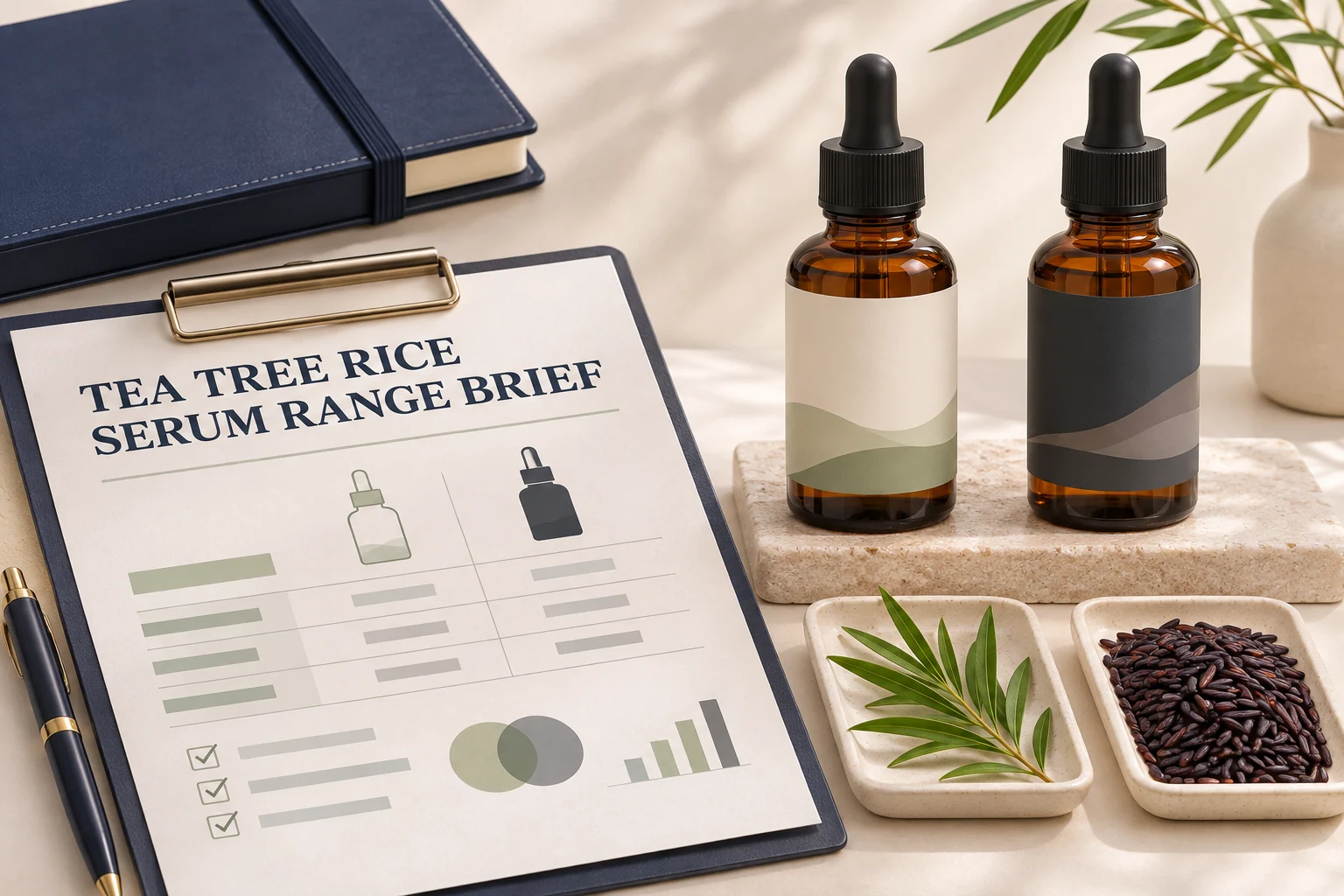
Write one sentence that explains when a customer would choose the Tea Tree Rice SKU rather than the other serum. The sentence should describe a supported use context or experience, not a medical condition or unsupported outcome. If the team can only say that one is “green” and the other is “black,” the brief is not yet differentiated.
Also define channel, target country, price architecture and assortment size as project inputs. These are buyer decisions, not facts published on the product page. A marketplace launch, salon range and professional distributor may need different levels of explanation and package hierarchy.
3. Compare confirmed catalog facts without filling gaps
Build a two-column matrix for name, reference, model, category, presentation and listed attributes. Label every row as catalog-stated, supplier-confirmed or buyer-proposed. Do not convert the listed moisturizing function into a finished-product performance result without supporting documents.
The current Tea Tree Rice page lists an organic ingredient attribute, but it does not define the scope or standard. Request the relevant documentation and proposed wording. Until reviewed, use “organic” only as an internal confirmation question, not a badge or front-label promise.
4. Request complete formula documents
Ask for the current complete INCI, formula revision, specifications, named-ingredient details and supporting documents for each sample. Confirm whether tea tree and rice appear in the formula, their INCI names and their intended formulation roles. Do not assume concentration, source, grade or benefit from the catalog name.
Compare formulas at the document level as well as the label level. Two products can have different names but a very similar base, or a similar naming pattern but meaningful differences. Only current documents tied to the tested sample can resolve that question.
5. Define directions and use context
Request confirmed directions covering application area, amount, frequency, leave-on or rinse status, warnings and storage. Then write the proposed customer routine in plain language. If two serums occupy different routine moments, those directions should make the distinction clear without overstating benefits.
Check whether customers could accidentally layer, substitute or confuse the products. If directions are effectively identical, the team needs a stronger formula, sensory, package or audience reason for a pair. Do not invent a scalp-condition segmentation that the documents do not support.
6. Use a matched sensory scorecard
Evaluate coded samples under the same controlled method. Record appearance, odor description, viscosity observation, pickup, spread, residue, drying behavior, applicator control and package handling. Include the amount, substrate or application context, room conditions and evaluator.
Sensory observations help a team compare samples; they are not universal consumer results. Avoid translating “felt lighter in one internal review” into a public superiority claim. If sensory difference is intended to drive positioning, confirm it across relevant samples and agreed acceptance criteria.
7. Separate evidence from proposed wording
Create four columns: proposed wording, evidence needed, evidence received and review status. Catalog attributes, ingredient information, supplier statements, finished-product tests and buyer-created marketing language are different evidence layers. Keep them visibly separate.
Claims about moisturizing, appearance, comfort or other performance need defined substantiation and market review. Ingredient presence alone does not prove a finished-product outcome. Medical, hair-growth or treatment language should not enter the brief without appropriate regulatory and evidence review.
8. Design names and artwork for fast choice
Test the two product names in a small listing card, search result, mobile product page and physical label mockup. Check whether the distinguishing words remain visible and whether the customer can understand the difference without reading a long paragraph.
Do not let decorative ingredient imagery imply an unconfirmed formula or benefit. Front-label language, botanical graphics, back-label INCI and directions must describe the same approved configuration. Reserve enough space for required market information before approving the visual concept.
9. Build a package-differentiation system
Confirm available bottle, applicator, closure, fill size, decoration and materials rather than assuming the catalog photography is the final package. Ask for component drawings, decoration areas, tolerances and compatibility information tied to the formula and fill process.
For a paired range, use a shared structural system where that helps recognition, then add accessible differentiation through names, high-contrast colors or other cues. Do not rely on color alone. Review leakage, dispensing, label adhesion and formula-component compatibility for each selected configuration.
10. Make the portfolio decision and define reopening triggers
Score each route against customer clarity, formula distinction, evidence readiness, operational complexity, package clarity and commercial fit. Record one decision: standalone, paired, merge, revise or stop. Include who approved it and which documents supported the decision.
Reopen the decision when the formula revision, directions, package, claim, target market, channel or companion SKU changes. A range position should not silently carry across a changed configuration. Request current MOQ, price and lead time only after the configuration is clear enough for a meaningful quotation.
A Practical Differentiation Matrix
Use a compact matrix during review:
- Identity: Record reference, model and revision for each SKU. Ask whether every document is traceable.
- Customer role: State the buyer-proposed use context for each SKU. Ask whether the choice is understandable.
- Formula: Compare confirmed INCI files and specifications. Ask whether there is a material distinction.
- Directions: Compare confirmed application instructions and warnings. Ask whether customers can use each correctly.
- Sensory: Compare controlled observations under the same method. Ask whether the experience is consistently distinct.
- Claims: Link proposed wording to evidence for each SKU. Ask whether every statement is supportable.
- Package: Record the confirmed component configuration for each SKU. Ask whether choice and compatibility are clear.
- Commercial: Request a current quote for each defined configuration. Ask whether the pair justifies added complexity.
An empty cell is not permission to improvise. It is a request for information, a reason to revise the plan or a decision to postpone the second SKU.
Hypothetical Buyer Review
Imagine a hypothetical buyer chooses two serum names, puts one in a green bottle and one in a dark bottle, then describes both as moisturizing scalp serums. The samples have no visible revision codes, and the buyer has not received complete INCI files or confirmed directions. Artwork adds ingredient benefit statements based only on the names.
The buyer should pause. Color and naming do not prove formula or customer-role differentiation, and the proposed statements are unsupported. The team relabels the samples, requests current documents, compares them under one scorecard and tests whether a customer can explain the choice. This is a planning example, not an actual customer case or test result.
Buyer FAQ
Does the name confirm tea tree and rice ingredients?
No. The catalog name identifies the product presentation, but the page does not publish a complete INCI. Request the current formula revision and ingredient declaration. Confirm INCI names, roles and supporting documents before using ingredient-led artwork or claims.
What does the listed organic attribute mean?
The page lists an organic ingredient attribute but does not define its scope, standard or documentation. Ask what material and evidence the attribute refers to, then review any proposed wording for the target market. Do not create an organic certification badge from the catalog field.
Can Tea Tree Rice and Rice Black serums be sold together?
They can be considered together, but the range needs a documented reason for each SKU. Compare identity, formula, directions, sensory experience, claims, package and commercial fit. If the difference is only the name or color, one clearer SKU may be stronger.
Is a different bottle color enough to differentiate the products?
No. Color can support navigation, but it cannot replace product-level distinction or formula compatibility review. Use names, directions and accessible visual cues together, and confirm the actual component configuration for each formula.
When should the team request a commercial quote?
Ask for a current quote after the formula, fill, component, decoration and quantity assumptions are sufficiently defined. MOQ, price, capacity and timing are configuration-specific and are not published on the current product page.
What to Send in Your Inquiry
- Reference 1602015879870 and model FAI-002251b.
- Target country, channel, audience and launch range size.
- Standalone or paired-range hypothesis and the intended customer choice.
- Request for sample code, formula revision, complete INCI, specifications, directions, warnings and storage guidance.
- Questions about the listed moisturizing function and organic ingredient attribute, including supporting documents and allowable wording.
- Companion SKU reference if a matched comparison is required.
- Desired fill size, applicator, bottle, closure, decoration and secondary packaging, all marked as requests until confirmed.
- Proposed claims and ingredient imagery requiring evidence and market review.
- Request for current MOQ, pricing, sample cost, capacity and lead time tied to the selected configuration.
Send the brief through the LANTHOME contact form, or use the sample request form to request identified samples and documents. Review How It Works before selecting a development pathway.
Related Links
- Tea Tree Rice Hair Serum - Review the exact product reference and current confirmation points.
- Scalp Serum Collection - Compare catalog options without transferring formula or performance facts.
- Rice Black Hair Serum - Review the companion reference as a separate product identity.
- Rice Black Hair Serum Product Brief - Organize formula and packaging questions for the companion SKU.
- How It Works - Review private-label, semi-custom and custom pathways.
- Request Haircare Samples - Request identified samples and current documents.
- Contact LANTHOME - Send range-positioning, formula, packaging and commercial questions.