
In this guide
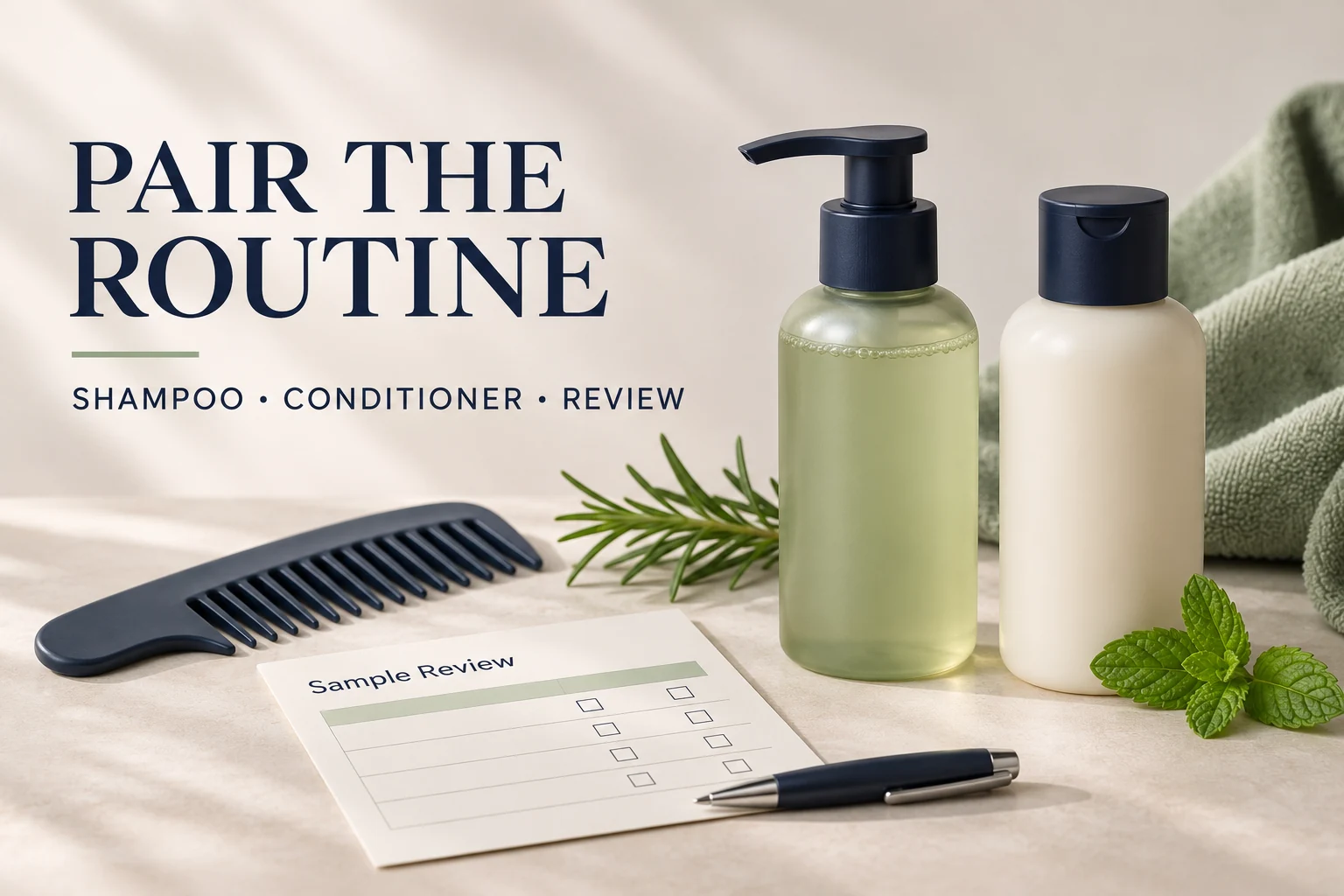
A private label shampoo and conditioner set should be reviewed as a paired routine and as two separately controlled products. Use the same identified shampoo, conditioner, direction versions and packaging proposal throughout the review; record the wash step and conditioning step separately; then assess whether the sequence, scent description, pack identification and consumer instructions work together. A favorable impression of the set does not confirm formula performance, ingredient percentages or claims.
LANTHOME lists the Rosemary Mint Keratin Shampoo & Conditioner Set, reference 1601955948266, model FAI-6354A, as a 100 mL shampoo and conditioner set available for Private Label / OEM / ODM enquiries. The page lists a moisturizing function, herbal scent and rosemary oil as source-listing information. It asks buyers to review the 100 mL format and confirm the current formulation, packaging, quantities and timing. It does not publish the complete INCI lists, rosemary-oil amount, keratin identity, individual bottle fill confirmation, final directions, test results, claim evidence or commercial terms.
This guide turns that limited catalog identity into a controlled buyer workflow. It does not assume that the two formulas share the same ingredients, fragrance level, package component or evidence. It also does not treat “100 mL set” as proof that each item has a 100 mL net content. Ask the supplier to identify each SKU, each fill and each document before the sample review begins.

Product Facts and Confirmation Points
- Catalog identity: The page names LANTHOME Rosemary Mint Keratin Shampoo & Conditioner Set, reference 1601955948266, model FAI-6354A. Put the reference and model on the request, sample labels and review record.
- Listed format: The page describes a 100 mL shampoo and conditioner set. Confirm whether 100 mL applies to each bottle, the total set, or another source-listing convention; confirm the net content of both proposed SKUs.
- Listed positioning: “Moisturizing function” and “herbal scent” are catalog statements, not proof of a finished-formula result or an approved public claim. Define intended wording and request applicable support.
- Listed ingredient direction: The page lists rosemary oil. The product name also includes mint and keratin. These words do not disclose complete INCI lists, ingredient identities, sources, amounts or roles for either SKU.
- Service scope: The page states Private Label / OEM / ODM and invites formula, packaging and quantity discussion. It does not publish a confirmed customization route for a specific proposal.
- Package gap: The final bottle materials, closures, decoration, secondary pack, component compatibility and label areas are not stated. Photographs are catalog references, not an approved package specification.
- Commercial gap: MOQ, price, production capacity and lead time are not published. Request current terms only after the two formulas, two packs and set configuration are defined.
Maintain three levels of identity. The catalog record identifies the source page. The sample record identifies the actual shampoo and conditioner formulas, fills, packages, direction versions and document dates. The approval record identifies the accepted production specifications, artwork and evidence. Do not let the set name replace either SKU record.
Which Review Route Fits the Decision?
The routes below answer different questions. A paired-routine review checks whether the set makes sense as one consumer sequence. A separate-SKU review checks whether each item is sufficiently defined and controllable. A complete decision normally needs both, but buyers may start with one depending on the unresolved risk.
Option 1: Paired-Routine Review
- Decision purpose: Determine whether the confirmed shampoo step and conditioner step form a clear sequence for the intended audience and channel.
- Application record: Use the supplier-confirmed directions for each item and record the transition between the two steps without inventing amounts, contact times or hair claims.
- Package check: Review whether the bottles can be distinguished in wet-use conditions and whether the set presentation preserves correct step order.
- Information check: Compare the names, directions, warnings, storage wording and scent description across the two labels and the outer set presentation.
- Evidence needed: Current formula identifiers, directions, ingredient information, package proposals and support for any set-level or product-level claim.
- Best use: Early routine design, pack hierarchy and instruction review when the buyer already expects both products to be sold together.
This route is useful when the commercial idea depends on the pair. It cannot show whether either SKU is ready for independent sale, and it should not collapse shampoo and conditioner observations into one score. Keep step-level notes so a revision can be assigned to the correct formula, pack or instruction.
Option 2: Separate-SKU Review
- Decision purpose: Establish whether the shampoo and conditioner can each be identified, instructed, packaged and reviewed on their own terms.
- Application record: Test each product only according to its own confirmed direction version. Record missing instructions as gaps rather than filling them from the companion product.
- Package check: Confirm the proposed fill, closure, dispensing action, label area and sample identity for each SKU before considering an outer set.
- Information check: Review each complete ingredient list, product description, warnings and claims separately; do not copy one label structure blindly to the other.
- Evidence needed: Two product specifications, two ingredient records, two direction records and applicable evidence tied to the exact formulas and packs.
- Best use: Supplier prequalification, formula selection or projects that may sell one item separately, change one SKU later or create different pack sizes.
This route creates stronger change control. It can take more documentation because the pair is treated as two products rather than one catalog unit. That extra clarity prevents a conditioner revision from being hidden inside a set approval and makes it easier to decide whether the set can proceed while one component remains on hold.
Build a Controlled Paired-Sample Review
1. Define the set decision before requesting samples
Write one answerable question: “Can these exact shampoo and conditioner samples support a clear two-step routine in our intended 100 mL set proposal?” State the target market, channel, routine context and whether the products must also work as stand-alone SKUs. Do not begin with an outcome such as “moisturizes dry hair” because the catalog statement is not finished-product evidence.
List what the first review will and will not approve. It may review instruction clarity, step order, scent description, package distinction and document completeness. It should not approve final claims, artwork, quantities or production timing unless the applicable specifications and evidence are separately available.
2. Request two identified samples, not one unnamed set
Ask for reference 1601955948266 and model FAI-6354A, then request a unique identifier for the shampoo formula and a separate identifier for the conditioner formula. Request the proposed net content of each item, the sample package reference, the current direction version and the document date. If the supplier uses a single set code, retain it as the parent identifier while preserving two child SKU records.
The sample label should make “shampoo” and “conditioner” immediately distinguishable. Color alone is not enough for internal control. The review form should include the set code, SKU role, formula or sample revision, pack reference, date received and reviewer. This prevents swapped samples or feedback attached to the wrong product.
3. Confirm the 100 mL statement and pack architecture
Ask exactly what the page’s 100 mL statement refers to. Confirm each nominal net content, bottle dimensions, closure type, decoration area and secondary pack proposal. A paired set may use visually coordinated bottles, but coordination must not hide product role, use order or mandatory information.
Discuss whether the project needs two bottles in one carton, a sleeve, a tray or no shared secondary pack. These are design questions, not catalog facts. Request current component specifications and compatibility information for the exact formulas and packs. Do not infer travel status, leak resistance, recyclability or shipping suitability from the size or image.
4. Lock the directions before comparing observations
Request separate confirmed directions for the shampoo and conditioner. The review sequence can record wetting context, shampoo application area, amount method, rinse step, conditioner application area, amount method and final rinse step only as supplied. If contact time, frequency or amount is missing, ask for clarification rather than inventing a standard routine.
Keep the sequence consistent across reviewers. Consistency improves the usefulness of observations, but it does not turn an internal review into clinical or consumer-test evidence. Record any deviation so product, sourcing and content teams can understand whether feedback relates to the formula or to an instruction that was not followed.
5. Separate formula observations from set experience
Build three note groups. Shampoo notes may cover dispensing, direction clarity, rinse sequence and neutral sensory observations. Conditioner notes may cover dispensing, application sequence, rinse sequence and neutral sensory observations. Set notes may cover product distinction, step order, scent continuity, storage and outer-pack information.
Do not use one overall star rating. A set may be easy to understand but contain an unresolved conditioner instruction, or both samples may be identified correctly while the outer pack confuses the order. Use go, revise or hold for each SKU and for the set layer. State the reason and next action.
6. Review herbal scent as a specification question
The page lists an herbal scent. Ask whether that description applies to both formulas, whether the scent is intended to match or complement, and what reference controls the approved character. Reviewers may record whether they can follow the description, but their preferences do not establish a fragrance specification or a public benefit claim.
If fragrance consistency matters, request how approved references, batches and changes are controlled. Do not promise natural origin, aromatherapy, scalp effects or ingredient-derived scent without applicable evidence. “Rosemary” and “mint” in the name can influence expectation; final wording should agree with the confirmed ingredient and fragrance information.
7. Audit rosemary, mint, keratin and moisturizing language
Create a claim-and-identity sheet for both products. Mark rosemary oil as source-listing information pending the current complete ingredient lists. Mark mint and keratin as name elements pending confirmation of the exact ingredient identities and their presence in each formula. Mark “moisturizing” as proposed positioning that requires definition and applicable support for the exact product and wording.
Do not copy a shampoo ingredient statement onto the conditioner or imply that both contain the same ingredients. Do not add percentage, origin, purity or mechanism language unless current documentation supports it. An ingredient can be present without supporting every associated benefit claim. The target-market review should address the final formulas, labels and intended wording.
8. Reconcile the two decisions into one set decision
After separate and paired reviews, create a short decision table in the project record. For each SKU, record formula identifier, pack reference, direction version, document status, open claim questions and decision. For the set, record step order, pack hierarchy, scent-description decision, outer-pack status and unresolved dependencies.
“Go” means the identified sample is suitable for the next defined stage, not that production or every claim is approved. “Revise” should name the formula, package, direction or artwork change. “Hold” should name the missing specification, ingredient record, evidence or commercial answer. The set proceeds only when both SKU decisions and the parent-set decision are compatible.
Plan the Set Information Hierarchy
The front of the set should make the two product roles clear before it emphasizes a shared story. Each bottle needs its own product identity and confirmed directions. The shared presentation can explain the sequence, but it should not replace ingredient declarations, warnings, storage information or other required details for either item.
Use matching terminology across bottles, outer pack, product page, sample sheet and customer-support material. If “Step 1” and “Step 2” are used, confirm that the directions and sales configuration actually support that fixed order. If the products may be sold separately, avoid wording that makes one bottle unintelligible without the other.
The Private Label Kids Shampoo two-step set guide offers a related information-architecture example, but it does not establish formula, audience or claim equivalence for this rosemary mint keratin set. Use it to compare set-level control questions, not as evidence about FAI-6354A.
Hypothetical Buyer Example
Consider a hypothetical brand planning a compact shampoo and conditioner trial set for an online launch. The team requests FAI-6354A and asks the supplier to identify each formula, each net content, each bottle and each direction version. The buyer records “100 mL” as pending interpretation until the supplier confirms the two fills. It does not advertise a travel claim.
Reviewers follow the supplied shampoo and conditioner directions in sequence. They record dispensing and rinse observations under the correct SKU, then record product distinction, step order and scent-description clarity under the set. The content team holds rosemary, mint, keratin and moisturizing statements until it reviews current ingredient information and evidence. Procurement requests price and timing only after the pack configuration is defined.
If the shampoo record is complete but the conditioner direction is unclear, the shampoo can receive “go to next review” while the conditioner and parent set remain “revise.” This is a planning example, not an actual customer case, result or endorsement. Its purpose is to show how separate records prevent one attractive set concept from hiding a component-level gap.
Frequently Asked Questions
Does “100 mL shampoo and conditioner set” mean each bottle contains 100 mL?
Not necessarily. The page lists a 100 mL set format but does not state whether that amount applies to each SKU or the set description as a whole. Ask the supplier to confirm the nominal net content and pack specification for both the shampoo and conditioner before creating labels, cartons, logistics records or public copy.
Does the product name confirm rosemary oil, mint and keratin in both formulas?
No. The page lists rosemary oil, while mint and keratin appear in the name, but it does not publish complete INCI lists for either product. Request separate current ingredient information for the shampoo and conditioner. Do not infer presence, amount, origin, role or benefit for either SKU from the shared set name.
Should the shampoo and conditioner use the same fragrance description?
Only if the exact proposals and approved fragrance information support it. Ask whether “herbal scent” applies to one or both formulas and how the intended references are controlled. Matching consumer language can help set coherence, but it should not conceal a material difference or imply natural origin or aromatherapy benefits.
Can the pair be approved with one overall sample score?
One score is not enough for change control. Record shampoo, conditioner and set-layer decisions separately. A combined preference can be a summary, but it should not replace formula identity, direction, package and evidence checks. The next action must show which component or shared presentation needs revision.
Does the 100 mL format make the set suitable for travel?
The page does not make that claim. Suitability depends on the exact fills, closures, secondary pack, destination rules and intended wording. Confirm the final package and arrange the applicable logistics and regulatory review before using travel-related language. A small-looking bottle or catalog image is not evidence of leak resistance or compliance.
What to Send in Your Inquiry
- Product identity: Reference 1601955948266, model FAI-6354A, with shampoo and conditioner identified as separate SKUs.
- Project decision: State whether the products will be sold only as a set, separately, or in both configurations.
- Formula records: Request current sample or formula identifiers, specifications and complete ingredient information for each item.
- Directions: Request separate application, amount, rinse, frequency, warning and storage information for the exact samples.
- Fill and pack: Confirm what 100 mL means, each net content, bottle and closure proposal, decoration area and outer-set configuration.
- Scent and claims: Define the intended herbal-scent, rosemary, mint, keratin and moisturizing wording and ask what current support applies.
- Market context: Provide target country or region, audience, channel and language requirements for the applicable review.
- Commercial questions: Request current customization route, quantities, price and timing for the fully defined two-SKU set proposal.
Send the controlled brief through the LANTHOME contact form or organize the two samples through the sample request form. Review How It Works before choosing a private-label, semi-custom or custom development pathway.
Related Links
- Rosemary Mint Keratin Shampoo & Conditioner Set · FAI-6354A- Review the exact catalog reference used for this paired-sample workflow.
- Shampoo Collection- Compare shampoo references while keeping formula and direction evidence separate.
- Conditioner Collection- Review conditioner formats that may help define the second step of a range.
- Private Label Kids Shampoo: How to Build a Two-Step Set- Compare a related set-control framework without assuming product equivalence.
- How It Works- Review the available private-label, semi-custom and custom project pathways.
- Request Haircare Samples- Organize identified shampoo and conditioner samples and feedback.
- Contact LANTHOME- Send the two-SKU brief, market context, packaging requirements and document questions.