
In this guide
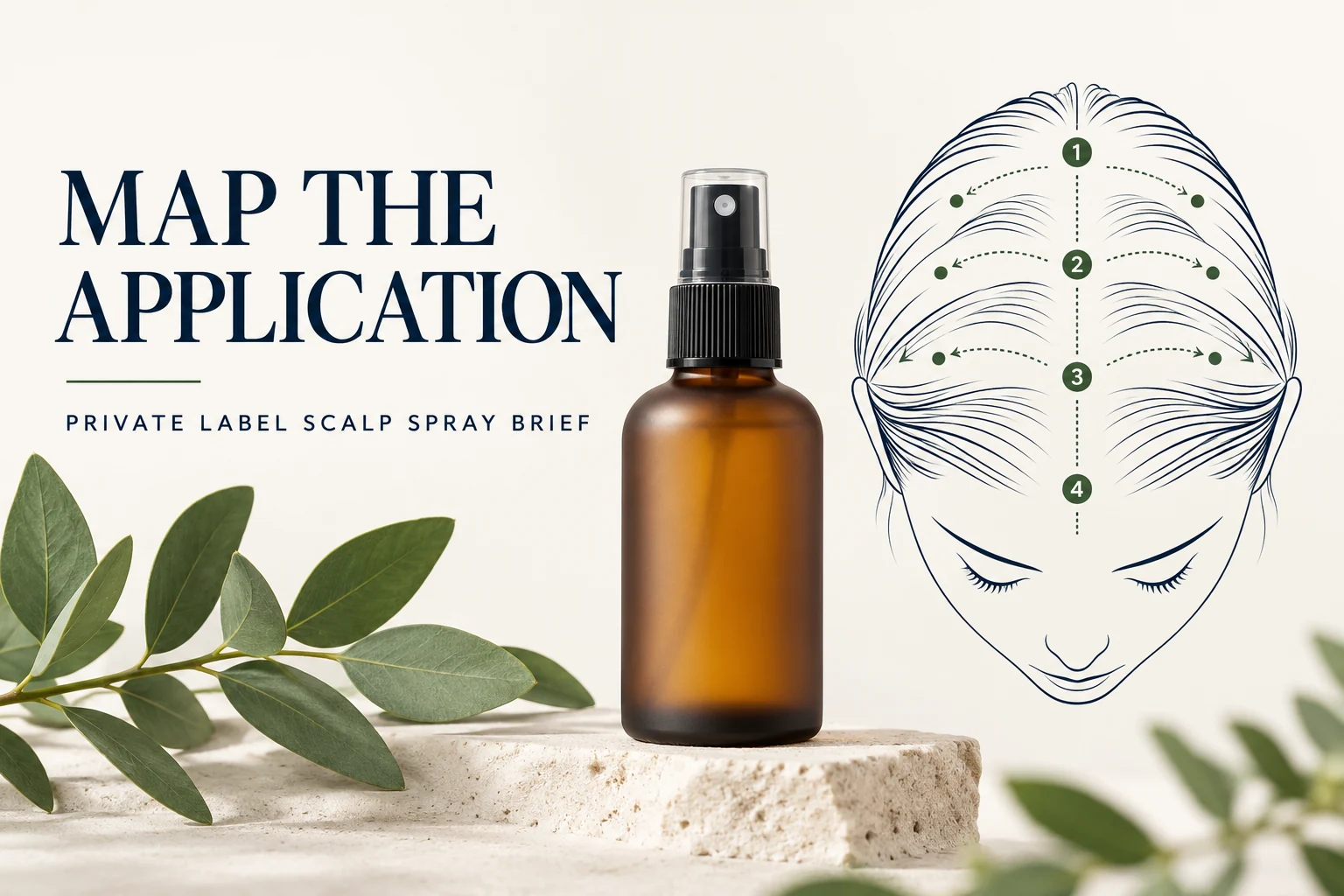
Build a private label scalp care spray brief by defining where the product should be applied, how the hair is parted, how the package is held and which directions must be confirmed before sampling. A clear application map gives reviewers the same routine and makes nozzle feedback comparable. It does not prove efficacy. Use the exact product reference, package configuration and supplier-confirmed directions in every review record.
LANTHOME lists Scalp Care Spray, reference 1601630566771, model HG-A03-0566-01, as a scalp care spray reference in the Scalp Serum collection. The page asks buyers to explain the application method and intended routine, review ingredient information and proposed claims for the target market, and confirm the current specification, ingredient list, packaging, quantities and timing. It does not publish a complete formula, spray count, dose, frequency, nozzle specification, fill size or performance result.
This guide turns those catalog facts into a buyer-controlled sample plan. It treats application mapping as an instruction and packaging question, not as a treatment protocol. The final routine must follow the current product specification and the target market’s review requirements. Any diagram or example used internally remains provisional until the supplier confirms it.
Product Facts and Confirmation Points
- **Catalog identity:** The page names Scalp Care Spray, reference 1601630566771, and model HG-A03-0566-01. Put both identifiers on the inquiry, sample label and feedback form.
- **Format and category:** The page identifies a scalp care spray in the Scalp Serum collection. Confirm whether the exact sample is leave-in or rinse-out and obtain the complete directions.
- **Application focus:** The page tells buyers to explain the application method and intended routine. It does not state a spray count, treatment zone or frequency.
- **Ingredient and claim review:** The page asks buyers to review current ingredient information and proposed claims for the target market. The catalog does not establish efficacy or regulatory acceptance.
- **Service scope:** The product is presented for Private Label / OEM / ODM enquiries. Confirm the applicable development route and the available formula, package and artwork choices.
- **Package gap:** The live page does not confirm nozzle output, spray pattern, closure, material, fill size, decoration area or compatibility results for the final proposal.
- **Commercial gap:** MOQ, price, capacity and lead time are not established on the page. Request current project-specific terms rather than reusing numbers from another item.
Maintain three evidence columns throughout development: catalog-stated, project-confirmed and needs-confirmation. A claim should not move into artwork merely because it appears in a product name or an internal idea list.
Which Application Pattern Should the Brief Evaluate?
The supplier-confirmed directions control the final routine. Before those directions are approved, buyers can compare two instruction patterns as planning options. Use the same dimensions so the package and content teams understand what changes.
Option 1: Section-by-Section Scalp Application
- **User action:** The user creates defined hair partings and applies product along one section at a time. Confirm whether this matches the current directions.
- **Package interaction:** Review the holding angle, distance, actuator control and whether the proposed nozzle can be aimed consistently at a visible section.
- **Instruction burden:** The label or product page may need a clear sequence for parting, applying and continuing through the intended zones. Do not publish a sequence before approval.
- **Observation method:** Record which sections were used, how the sample was identified and whether reviewers followed the same provisional map.
- **Evidence needed:** Obtain current directions, package information and support for any proposed scalp-care wording. The application map does not establish a result.
This route may be useful when the buyer wants reviewers to examine controlled placement and repeatable sectioning. It also creates more instruction steps, so clarity becomes part of the product review.
Option 2: Broader Surface Application
- **User action:** The user applies across a broader planned area with fewer defined partings. Confirm whether this approach is permitted by the exact product directions.
- **Package interaction:** Review spray spread, holding position and the ability to avoid unintended contact under the approved use method.
- **Instruction burden:** Directions may be shorter, but they still need an amount method, distance, frequency and precautions confirmed by the supplier.
- **Observation method:** Record the planned zones and how reviewers kept the application area consistent rather than describing it only as “all over.”
- **Evidence needed:** Obtain the same formula, packaging and claim documents required for the sectioned route. A broad pattern is not evidence of greater coverage or performance.
This route may be useful when the intended routine values fewer steps. It should not be assumed from a generic spray format. The actual nozzle, formula and confirmed directions determine whether the pattern belongs in the project.
The Scalp Serum Collection shows the category context. The roll-on scalp serum applicator guide explains a different contact-led format. Reading both helps a buyer separate the customer task from the applicator without assuming that spray and roll-on formulas are interchangeable.
How to Build a Repeatable Sample Review
1. Write the target question first
Define the one decision the first sample round must answer. Examples include whether the proposed nozzle supports the intended sectioning routine, whether the instructions are understandable or whether the package can present the required information. Do not ask the first sample to prove every marketing idea.
Write the intended audience, target market, sales channel and haircare routine in one paragraph. State which details are requirements and which remain questions. If the product is intended for a specific routine position, confirm that position against the current directions before testing.
The output is a decision statement with proceed, revise and hold conditions. This prevents general enthusiasm from replacing the brief.
2. Request the exact sample system
Ask for model HG-A03-0566-01 and identify the proposed bottle, actuator and closure. Request the current product specification, complete ingredient list, directions, warnings and package information available for the project. If more than one nozzle is supplied, assign a unique configuration code to each.
Keep formula and package records linked. “Spray sample” is not enough. The record should show product model, formula or sample identifier, bottle, nozzle, closure and date received. If the formula or actuator changes, start a new comparison row rather than overwriting the first result.
The next action is a sample matrix that states what is common and what differs across configurations.
3. Convert directions into an application map
After receiving current directions, translate them into a simple internal map: starting position, number or type of sections, intended application area, package orientation, confirmed amount method and what happens after application. Keep the original directions beside the map so reviewers can identify any interpretation.
Do not invent a spray count. If the amount is described by another method, preserve that method. If the directions are incomplete or ambiguous, pause the review and request clarification. A visually attractive map is not approval.
Use neutral labels such as Zone A, Zone B and Zone C during early review. Avoid medical or problem-focused labels unless the final project has applicable evidence and approval.
4. Standardize the review conditions
Give reviewers the same sample configuration, directions and observation form. Record whether hair was dry or wet only if that condition appears in the confirmed routine. Record package position, application sequence and any deviation from the map.
Useful observations include actuator control, ability to aim at the planned zone, spray interruption, visible residue around the nozzle, closure handling, instruction clarity and unanswered questions. These are internal development notes. They should not be converted automatically into public claims.
Avoid unsupported scores. If a rating scale is used, define each level. A written observation such as “reviewer could not identify the next section from the draft diagram” gives the content team a specific revision.
5. Review the package and information together
The applicator is part of the instruction system. Confirm the printable area, label orientation, cap or overcap, batch-marking space and secondary packaging if proposed. Check whether essential directions remain legible at actual size.
Review the digital product page at the same time. A complex sectioning routine may need a diagram or demonstration outside the primary label, but the required information cannot simply be omitted from the package. Determine which content belongs on-pack, which belongs in approved supporting material and how the user reaches it.
The next action is an information inventory showing the source, approval status, location and owner for every statement.
6. Separate handling feedback from claims
A reviewer may observe that a nozzle feels easy to aim under a specific setup. That observation does not prove clinical benefit, scalp absorption, reduced shedding, growth, soothing or another outcome. Keep handling and sensory notes in the sample record while the claim file follows its own evidence review.
The product page specifically asks buyers to review ingredient information and proposed claims for the target market. Request the complete current documentation. Remove any unsupported wording from the brief rather than converting it into softer but still unverified language.
The next action is a claims table with proposed wording, evidence source, market review status and final decision.
7. Decide proceed, revise or hold
Proceed when the exact sample system supports the intended routine and the required inputs exist for the next stage. Revise when a defined problem can be addressed, such as nozzle control, draft instructions or label hierarchy. Hold when product directions, package information or claim evidence are too incomplete to make a responsible decision.
Record the reason, owner and due item. “Revise spray” should identify the exact component or instruction issue. “Proceed” should name the configuration and list remaining confirmations. Never treat a render or catalog image as a final component approval.
Worked Example: Turning a Spray Idea into a Brief
Consider a hypothetical online haircare brand exploring one scalp spray. It selects reference 1601630566771 because the site identifies model HG-A03-0566-01 as a Scalp Care Spray. The team has not approved the formula, ingredients, package, directions or claims.
The buyer defines the first decision: can a proposed spray configuration support a clear section-by-section application routine for a self-service ecommerce customer? The question concerns instructions and package handling. It does not assume a biological outcome.
The supplier is asked for the current specification, ingredient list, directions, warnings and one filled package sample with the proposed bottle and actuator. The buyer requests component identifiers and available package drawings. Any quantity, price and timing discussion is recorded separately as current commercial information.
After directions arrive, the team drafts a neutral application map. It uses lettered zones and the confirmed amount method. Reviewers receive the same map and record nozzle control, ability to reach the intended zone, closure handling, visible residue, instruction gaps and deviations. They do not invent a number of sprays or add a massage step unless the approved directions include it.
The content team checks whether the package can carry the required directions and warnings. The ecommerce team checks whether product images and supporting content explain the routine accurately. The regulatory or market-review owner assesses proposed claims against current evidence. Each stream keeps its own approval status.
The result may be proceed, revise or hold. A proceed decision identifies the exact sample configuration. A revise decision names the nozzle or instruction issue. A hold decision identifies missing documents. This example is not a customer case and does not report a result for HG-A03-0566-01; it illustrates a controlled buyer process.
Questions to Resolve Before Artwork
What amount should the directions state?
Use only the amount method confirmed for the exact formula and applicator. The live page does not publish a spray count, dose or frequency. Ask the supplier for current directions and ensure the package output is considered in the final wording.
What package data should be requested?
Request proposed bottle, actuator and closure identifiers, dimensions, decoration area, fill configuration and applicable compatibility or transport information. The available documents depend on project stage. Record missing data instead of filling it from a generic package listing.
How should the application map appear?
Choose a diagram style only after the routine is confirmed. Use simple zones, clear sequence and accessible labels. Check the map at actual package and mobile-screen sizes. Do not use medical imagery or imply treatment of a condition without applicable evidence.
Can the product name support ingredient or performance claims?
No. “Scalp Care Spray” identifies the catalog reference but does not disclose a full formula or validate an outcome. Review the current ingredient list, claim support and target-market requirements before approving consumer-facing wording.
Frequently Asked Questions
Is HG-A03-0566-01 confirmed as leave-in?
The live page identifies a scalp care spray but does not publish complete directions or confirm leave-in versus rinse-out use. Request the current directions for the exact sample and use them consistently in testing, artwork and digital content.
Does the page confirm how many sprays to use?
No. It does not state a spray count, dose or frequency. Do not create those values from a packaging test. Confirm the amount method with the supplier and connect it to the actual actuator configuration.
Should a buyer test the nozzle without formula?
An empty package can support an early grip and actuator review, but it cannot show filled-product spray behavior or residue. Label empty-pack observations separately and request a filled system before making decisions that depend on product output.
Can internal reviewer feedback become a marketing claim?
Not automatically. Internal handling and sensory observations help development teams revise a brief. Consumer-facing claims require applicable evidence and market review for the final product. Preserve the source and status of every statement.
What makes the sample review repeatable?
Use the same identified sample system, confirmed directions, application map, conditions and observation fields. Record deviations and unresolved questions. Repeatability improves development feedback; it does not turn a small internal review into performance evidence.
What to Send in Your Inquiry
Use the LANTHOME project inquiry or sample request form with these inputs:
- **Product reference:** Scalp Care Spray, reference 1601630566771, model HG-A03-0566-01.
- **Target market and channel:** Country or region, intended sales channel and user context.
- **Routine question:** Intended application zones and the decision the first sample should answer.
- **Sample system:** Formula or sample identifier plus proposed bottle, actuator and closure.
- **Documents requested:** Current specification, ingredient list, directions, warnings and package information.
- **Content needs:** Confirmed amount method, application sequence and information required for packaging and ecommerce.
- **Commercial questions:** Current customization route, artwork inputs, quantity options, pricing and timing.
Related Links
- Scalp Care Spray · HG-A03-0566-01- Review the exact spray-format product reference used in this brief.
- Scalp Serum Collection- Browse current scalp serum and applicator references.
- Rosemary Roll-On Serum · FP-A060-win- Compare a different applicator format without assuming formula equivalence.
- Private Label Roll-On Scalp Serum: An Applicator Brief- Review contact-led applicator questions for a related category.
- How It Works- Review private label, semi-custom and custom project pathways.
- Request Haircare Samples- Organize a sample request around a defined routine and applicator question.
- Contact LANTHOME- Send the product reference, target market and confirmation list.