
In this guide
A private-label buyer should not choose a package, request artwork or compare quotations until the serum’s correct fill size is confirmed in writing. LANTHOME’s page for this multi-peptide hair serum selects a 100 mL source variant, while the front product image is labeled 30 mL. Treat those as two conflicting source signals—not as proof that both sizes are currently available—and create one configuration record that identifies the exact sample, fill, component and artwork.
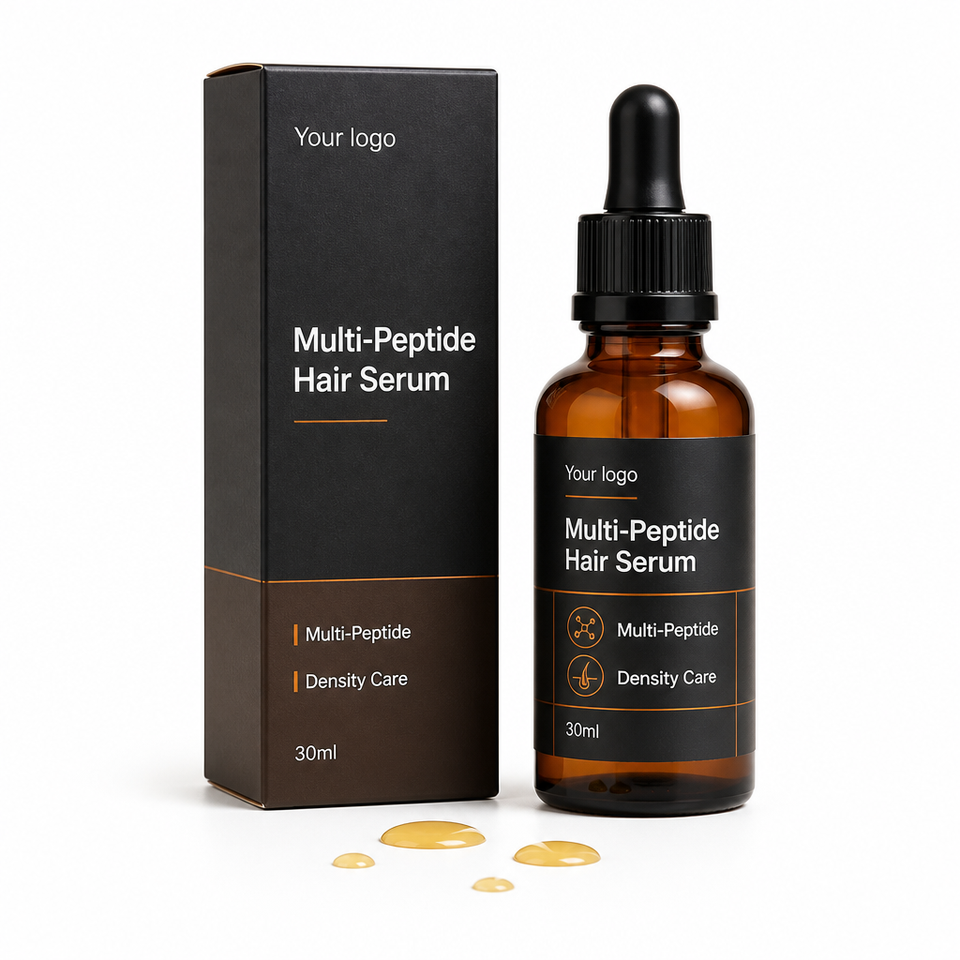
LANTHOME lists Multi-Peptide Hair Serum, reference 1602015633042, model FAI-002191b, for home daily use. The page states that the selected source variant is 100 mL and that the front product image shows a 30 mL label. It also lists China as the country of origin and Private Label / OEM / ODM customization. The page does not publish the complete INCI, peptide identities or levels, use directions, package specification, proof that both fills are offered, finished-product evidence or commercial terms.
The first task is therefore source reconciliation, not size strategy. A selected variant can describe one source record, while an image can show a different photographed configuration. Neither signal alone confirms what will be sampled, quoted or produced for a buyer. This article explains how to lock one verifiable configuration without inventing availability, performance, MOQ, price, capacity or lead time.
Product Facts and Confirmation Points
- Catalog identity: LANTHOME Multi-Peptide Hair Serum, reference 1602015633042, model FAI-002191b.
- Selected source variant: The page states 100 mL.
- Front-image label: The page states that the front image is labeled 30 mL.
- Use context: Home daily use is listed. Exact application area, amount, sequence and frequency are not published.
- Origin: China is listed as the country of origin.
- Customization: Private Label / OEM / ODM is listed; the buyer is invited to discuss formula, packaging and quantity.
- Availability gap: The page does not establish that both 30 mL and 100 mL are currently available for the same formula and component system.
- Formula gap: Complete INCI, peptide identities or levels, texture and current specification are not published.
- Commercial gap: MOQ, price, capacity and lead time are not published for either configuration.
Open a discrepancy record with two evidence rows: “100 mL selected source variant” and “30 mL front-image label.” Give both a catalog-stated status and leave the project fill unresolved. The project record should move to confirmed only when the supplier identifies the exact fill, formula revision, component codes, sample code and artwork basis together.
Which Verification Route Fits the Project?
The following routes organize the questions; they do not assert that either size is available. Compare them using the same dimensions: evidence basis, sample request, package record, artwork risk and next action. Do not ask for two SKUs until the supplier has confirmed two actual configurations.
Route A: Verify the 100 mL Selected Variant
- Evidence basis: The source page selects 100 mL.
- Sample request: Ask whether the current FAI-002191b sample and specification correspond to a 100 mL fill.
- Package record: Request the 100 mL container, closure, dimensions, materials, decoration area and component codes.
- Artwork risk: Reusing the photographed 30 mL label or proportions could create an inaccurate representation.
- Next action: Obtain written confirmation that formula, fill, components and sample identity all refer to the same 100 mL configuration.
This route gives priority to the selected source variant, but selection is not a finished specification. Ask for the current proposal and do not redraw the photographed bottle as if it were the 100 mL component. If the supplier confirms a different package for 100 mL, update photography and artwork references accordingly.
Route B: Verify the 30 mL Image Configuration
- Evidence basis: The front product image shows a 30 mL label.
- Sample request: Ask whether the photographed 30 mL configuration is current, sampleable and linked to model FAI-002191b.
- Package record: Request the exact 30 mL component codes and current artwork or photography status.
- Artwork risk: Treating an image label as an offered variant may create a nonexistent SKU or incorrect quote brief.
- Next action: Require written confirmation before using the 30 mL size in a request, listing, range plan or customer communication.
This route begins with visual evidence but keeps its limitations explicit. A photograph can document a past, sample or promotional configuration without proving current availability. Confirm whether the pictured fill, bottle, closure and formula still belong together. If not, retain the image only as an internal discrepancy reference.
How to Resolve the Size Conflict Before Sampling
1. Preserve both source signals
Save the page URL, check date, reference, model, selected 100 mL value and the note that the front image displays 30 mL. Keep screenshots or source snapshots where project policy permits. Do not edit one signal out of the record to make the page appear consistent.
Name the issue plainly: “fill-size conflict awaiting supplier confirmation.” This prevents purchasing, design and sales teams from choosing whichever value suits their immediate task. A shared discrepancy label also makes later resolution auditable.
2. Ask one configuration question
Send a short question that requires a configuration-level answer: “For model FAI-002191b, which fill size, formula revision, sample code, container and closure are included in the current proposal?” Avoid asking only “Is it 30 or 100 mL?” because the supplier may confirm a size without connecting it to the sample or package.
Request the response in a form that can be retained with the project. Verbal clarification can guide a discussion, but the approval record should identify the exact fields. If both sizes are proposed, require a separate row for each.
3. Build a size-specific configuration sheet
For each confirmed option, record product reference, model, formula revision, fill quantity, fill tolerance if provided, container code, closure code, label area, secondary pack, sample code and current status. Leave unknown fields blank or marked pending; do not fill them from category norms.
Use one configuration ID per combination. A 30 mL bottle and a 100 mL bottle are not merely two artwork sizes. They can involve different components, decoration areas, shipping considerations and instructions. A change to any linked field should produce a new revision.
4. Confirm formula identity separately from fill
Ask whether both proposed fills, if both exist, use the same exact formula revision. The public page names a multi-peptide hair serum but does not publish the complete INCI or peptide details. Do not assume formula equivalence across sizes or infer performance from the name.
Request current ingredient information and specification for the actual sample. Keep peptide naming and claim review separate from size confirmation. Resolving 30 mL versus 100 mL does not validate ingredient levels, efficacy or customer-facing benefits.
5. Lock the intended use directions
The page lists home daily use, but does not provide application area, hair condition, amount, sequence, exact frequency, rinse status, storage or warnings. Request current directions for the selected formula and size. A larger fill should not automatically lead to a larger amount or different frequency.
Check whether the proposed dispenser and direction work together. Do not invent a drop count, pump count or number of uses from the nominal fill. Those values require product- and component-specific support.
6. Review the physical sample against the sheet
When a sample arrives, photograph its front, back, base, closure and any secondary pack. Record the received fill label, sample code and component identifiers. Compare them with the approved configuration sheet before evaluating appearance or handling.
If the sample says 30 mL while the request says 100 mL, stop the review and resolve identity first. Feedback on the wrong configuration should not be attached to the intended SKU. Preserve the received item as evidence and request a corrected sample or corrected brief.
7. Control photography and mockups
Create an image-use register for each product visual: source URL, visible fill, visible packaging, date, approved use and limitations. The existing front image may be useful for discussing the discrepancy, but it should not automatically appear in a 100 mL retail listing or artwork proof.
For concept mockups, label them as concepts and use proportions that do not imply an approved component. For final photography, use the actual approved package and artwork. Confirm that alt text, captions and product data repeat the same fill.
8. Reconcile quote, purchase and artwork records
Before approval, compare the quote, sample request, component sheet, artwork, purchase description and product listing. Reference, model, fill, formula revision and package codes should agree. Do not accept a quote that says only “hair serum” if two size records remain in circulation.
Create a simple mismatch rule: any difference in fill or component code returns the package to clarification. This is more reliable than asking reviewers to remember which screenshot or message was most recent.
9. Decide whether one or two SKUs are justified
If the supplier confirms both configurations, then evaluate whether the brand needs both. Define the customer role, channel, package, information needs and operational purpose for each. This decision happens after availability is proven, not before.
Do not assume 30 mL is a trial or travel size, or that 100 mL is a full-size retail unit. Those are possible planning roles, not facts on this page. State a role only after the brand selects and supports it.
10. Issue a final configuration decision
Use proceed, revise or hold. “Proceed” identifies one exact configuration and next stage. “Revise” identifies the conflicting field and new evidence. “Hold” lists the missing supplier confirmation. Include the approver and date.
Define reopening triggers: formula revision, fill change, container or closure change, artwork change, target-market change, or replacement photography. A final size decision is only useful while its linked records remain unchanged.
Keep Size Verification Separate From Size Strategy
The 30 mL versus 100 mL caffeine hair-oil guide discusses how two confirmed fills might serve different range roles. It does not establish the availability or role of either size for FAI-002191b. Use it only after this serum’s configurations are verified.
The roll-on scalp serum applicator brief shows why application and component mechanics should be reviewed together. It concerns another catalog reference and cannot supply directions, formula facts or package evidence for this multi-peptide serum.
Hypothetical Buyer Review
Consider a hypothetical buyer who copies “100 mL” from the selected variant into a quote request but sends the front image as the package reference. The designer builds a 30 mL-shaped label layout, while purchasing expects a 100 mL bottle. Neither team has component codes or a confirmed sample.
The buyer pauses both tasks and opens one discrepancy record. The supplier is asked to identify the current fill, formula revision, sample code, bottle and closure. Only after those fields agree does the buyer release the quote brief and artwork dimensions. If both configurations are confirmed, each receives a separate ID.
This example shows how a small source conflict can spread into packaging work. It is a planning scenario, not an actual customer case, product offer, test result, MOQ, price or lead time.
Buyer FAQ
Does the page prove that both 30 mL and 100 mL are available?
No. It states that the selected source variant is 100 mL and that the front image shows a 30 mL label. Confirm current availability and the complete configuration for each size before treating either as an offered private-label option.
Which size should be used in the first sample request?
Use the size that the supplier confirms for the exact sample, formula revision and package proposal. If the conflict is unresolved, identify both source signals in the request and ask for one configuration-level answer rather than choosing a value yourself.
Can the 30 mL image be used to market a 100 mL product?
Not as an accurate final product representation. The visible fill and package can mislead buyers. Use approved photography of the selected 100 mL configuration, or clearly mark a temporary mockup as conceptual until final components and artwork are confirmed.
Does “multi-peptide” prove the ingredient list or performance?
No. The catalog name does not publish peptide identities, levels, complete INCI or efficacy evidence. Request current formula documents and review each proposed ingredient or performance statement separately from the size decision.
What must match before artwork approval?
At minimum, product reference, model, formula revision, fill, container and closure codes, decoration area, sample identity and directions should agree across the configuration sheet, quote and artwork. Resolve any mismatch before approval.
What to Send in Your Inquiry
- Product identity: Reference 1602015633042 and model FAI-002191b.
- Conflict statement: Note the 100 mL selected variant and 30 mL front-image label.
- Configuration request: Ask which fill, formula revision, sample code, container and closure are current.
- Formula request: Request specification and complete ingredient information for the actual sample.
- Directions: Request application area, hair condition, amount method, sequence, frequency, rinse status, storage and warnings.
- Package brief: Ask for component codes, materials, dimensions, decoration area and secondary pack.
- Market scope: State target country, channel and required label language.
- Commercial request: Ask for current quantities, pricing and timing only for the confirmed configuration.
Send the discrepancy record through the LANTHOME contact form or request an identified sample through the sample request form. Review How It Works before selecting a development pathway.
Related Links
- LANTHOME Multi-Peptide Hair Serum- Review the exact FAI-002191b page and its 100 mL versus 30 mL source conflict.
- Scalp Serum Collection- Compare current serum references without transferring formula or package facts.
- Private Label Caffeine Hair Treatment Oil: 30 mL or 100 mL?- Consider SKU roles only after availability is confirmed.
- Private Label Roll-On Scalp Serum: An Applicator Brief- Review component and application questions for another serum reference.
- How It Works- Review private-label, semi-custom and custom pathways.
- Request Haircare Samples- Request the identified formula and confirmed package configuration.
- Contact LANTHOME- Send the size discrepancy, formula, package and commercial questions.