
In this guide
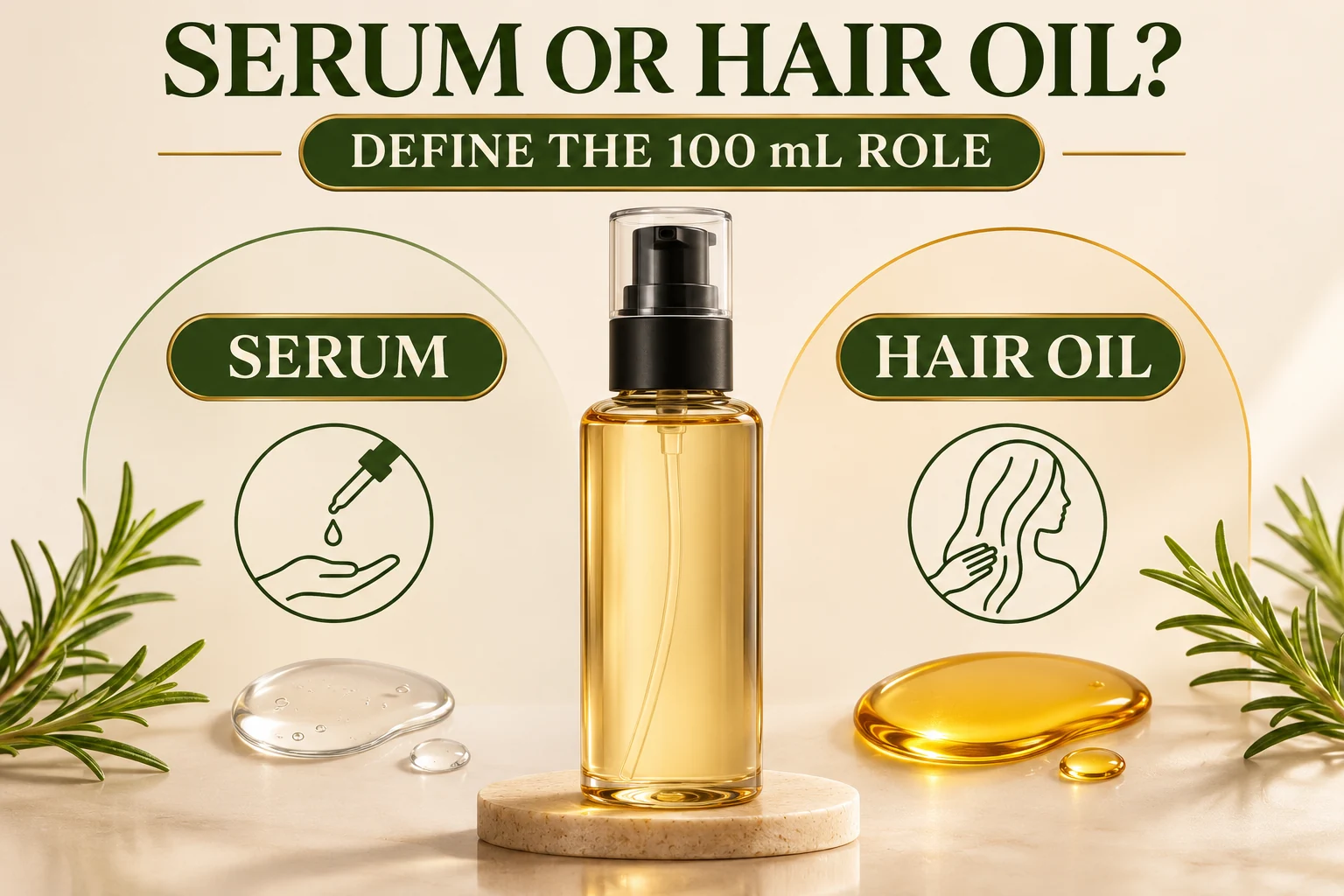
A private-label buyer should define whether a 100 mL rosemary hair oil serum will be presented primarily as a serum or as a hair oil before approving samples and artwork. The choice should follow the exact formula, confirmed use directions, texture, dispenser and intended routine—not the product name alone. LANTHOME lists both “hair oil” and “serum” in the catalog identity, so the buyer must resolve the customer-facing role rather than assume the two words are interchangeable.
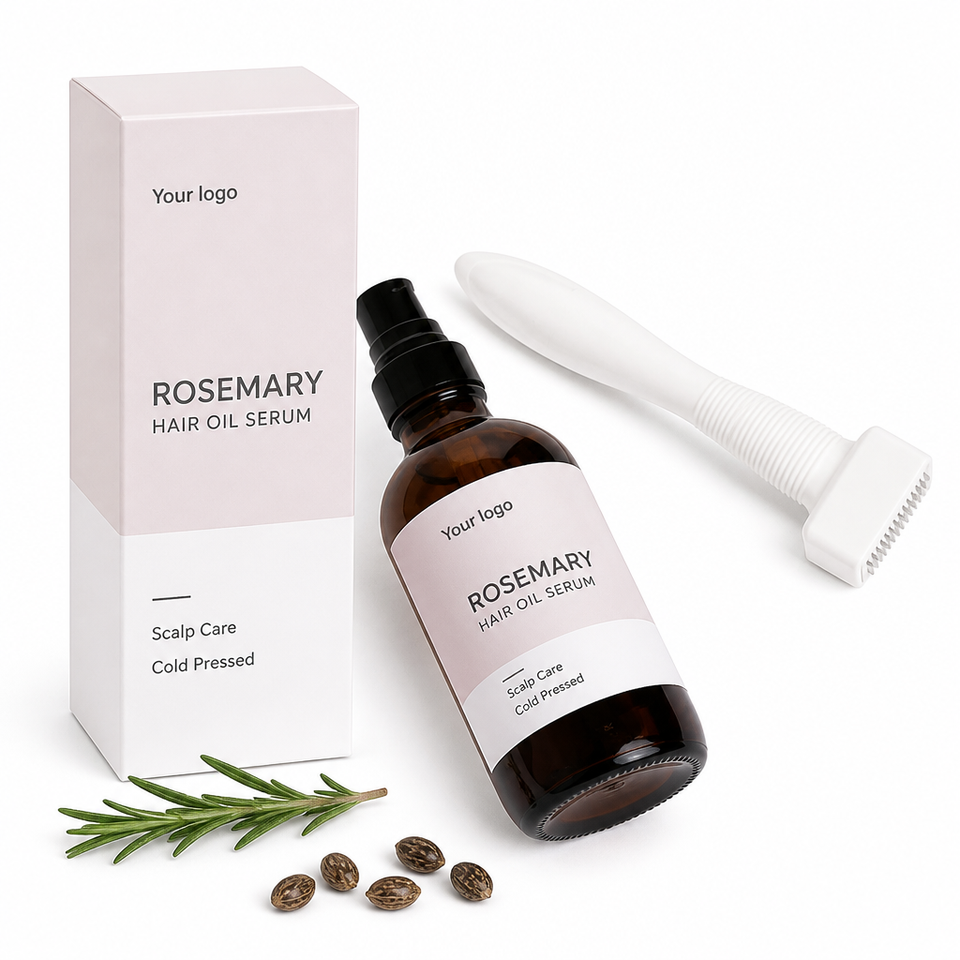
LANTHOME lists Rosemary Hair Oil Serum, reference 1602015494755, model FAI-002255b, in a source-listed 100 mL format. The page lists a moisturizing function, adult and unisex suitability, China as the country of origin, and Private Label / OEM / ODM customization. It asks buyers to confirm the current formula, scent and packaging with the team. The page does not publish the complete INCI, rosemary identity or level, viscosity, directions, application area, dispenser specification, finished-product evidence or commercial terms.
That creates a naming and instruction decision. “Serum” can lead buyers to expect a targeted, controlled application, while “hair oil” can suggest a finish-oriented or broader distribution step. Those are general customer expectations, not facts about this formula. The current page does not establish scalp use, leave-in status, wet- or dry-hair use, a drop count or a treatment outcome. This guide keeps those items as questions until the exact sample and documents answer them.
Product Facts and Confirmation Points
- Catalog identity: LANTHOME Rosemary Hair Oil Serum, reference 1602015494755, model FAI-002255b.
- Listed format: 100 mL. The page does not establish the final bottle, closure, pump, dropper or dispensing amount for a private-label project.
- Listed function: Moisturizing. The page does not publish the exact approved wording or finished-product support for the proposed configuration.
- Listed audience: Adult and unisex suitability. Confirm the target consumer and market-specific presentation for the project.
- Origin: China is listed as the country of origin.
- Customization: Private Label / OEM / ODM is listed; current formula, scent and packaging are to be discussed with the team.
- Formula gap: Complete INCI, ingredient order, rosemary identity or level, texture and specification are not published.
- Direction gap: Application area, hair condition, amount, frequency, sequence, rinse status, storage and warnings are not published.
- Commercial gap: MOQ, price, capacity and lead time are not published for a locked formula and package.
Create a role-definition record before sampling. Link the catalog reference, sample code, formula revision, naming route, confirmed directions, dispenser, target market and artwork revision. Use statuses such as catalog-stated, proposed, awaiting documents, supported, rejected and approved. Catalog wording identifies the starting point; it does not approve a final name or claim.
Which Naming Route Fits the Project?
Compare two routes using the same questions: primary role, application language, package implication, evidence need and customer-confusion risk. These are planning alternatives, not statements that the listed product already supports either route. A third hybrid name may be possible, but only if it remains clear and the final formula and directions support it.
Route A: Lead With “Hair Serum”
- Primary role: A focused step in a defined haircare routine.
- Application language: Confirm where the product is applied, at what point, to what hair condition and with which amount method.
- Package implication: A controlled dispenser may help communicate the intended amount, but the current page does not specify one.
- Evidence need: Any moisturizing or other proposed benefit must match the exact formula, directions and supporting record.
- Main risk: “Serum” may encourage customers to infer scalp use, treatment action or concentrated actives that the page does not establish.
Choose this route only after the supplier confirms that the product’s actual use and package make the serum identity understandable. Do not add scalp, root, growth, repair, anti-hair-loss or treatment language simply because “serum” appears in the title. If application is limited to lengths or ends, say so only after that direction is confirmed.
Route B: Lead With “Hair Oil”
- Primary role: An oil-format or oil-positioned step with a clearly stated place in the routine.
- Application language: Confirm whether use is before, during or after another step and whether hair is wet, damp or dry.
- Package implication: The closure and amount method must suit the actual texture and 100 mL presentation.
- Evidence need: Finish, manageability, shine or other wording cannot be inferred from the category; each proposed statement needs support.
- Main risk: Customers may assume a rich oil texture, a finishing role or indefinite leave-in use that the exact formula and directions may not support.
This route can make the product category easier to scan, but it still needs precise directions. “Hair oil” does not establish ingredient composition, oil percentage, application area or performance. A product can carry an oil-oriented name without giving the buyer permission to invent a blend story or benefit list.
How to Define the 100 mL Role Before Sampling
1. Freeze the catalog reference and decision question
Record reference 1602015494755, model FAI-002255b and the source-listed 100 mL format. Mark “Rosemary Hair Oil Serum” as catalog identity and the primary consumer-facing role as undecided. This prevents an early label mockup from silently deciding the product architecture.
Write one question at the top of the brief: should the customer understand this first as a serum, a hair oil, or a supplier-confirmed hybrid? Every later choice—directions, closure, claims and front-panel hierarchy—should help answer that question consistently.
2. Request the exact formula and sample identity
Ask for the current sample code, formula revision, specification and complete ingredient information. Request clarification of the rosemary-related ingredient identity rather than assuming it from the product name or botanical imagery. Do not infer percentage, origin, extraction, concentration or efficacy.
Tie all observations to the identified sample. If the formula changes, reopen the naming, direction and package decisions. Feedback from one revision should not automatically transfer to another, even when both use the same catalog reference.
3. Confirm texture and intended routine role
Ask the supplier how the current formula is intended to be used and what product type its specification identifies. Request application area, hair condition, amount method, sequence, frequency, rinse status, storage and warnings. The public page does not provide these details.
Avoid selecting a name solely from visual viscosity. A lightweight appearance does not prove serum use, and an amber appearance does not prove a specific oil blend or finish. Use the current specification and directions as the control, then evaluate whether the selected name helps customers follow them.
4. Define the audience without overextending it
The page lists adult and unisex suitability. Translate that into a project question: who is the intended buyer and what routine problem should the information solve? Do not convert “adult” into suitability for every adult hair type or “unisex” into a performance claim.
Record target market, language, channel and consumer information needs. A salon-facing brief may organize information differently from a direct-to-consumer listing, but both still need the same underlying identity, directions and support. Channel context changes presentation, not formula facts.
5. Choose the dispenser after the amount method
Request the proposed 100 mL bottle, closure or pump, component materials, dimensions, decoration area and supplier codes. The page confirms volume, not the package mechanics. Decide how the amount will be communicated before treating a dropper, pump or cap as final.
Review the exact sample in the selected component. Record opening, closing, dispensing, product access, cleanup, label readability and component condition. Do not turn one review into “precise dose,” “leak-proof,” “mess-free” or “travel-safe” wording without appropriate support. If the dispenser changes, repeat the relevant review.
6. Separate the rosemary story from the claim story
The product name contains rosemary and the page lists moisturizing. These are two different records. The ingredient record asks what the exact formula contains and which ingredient wording is accurate. The claim record asks what finished-product statement is proposed and what support applies.
Do not use general expectations about rosemary to fill evidence gaps. Avoid hair growth, anti-hair-loss, scalp treatment, repair or therapeutic implications. None is established by the product page. If the project proposes additional wording, request current formula-specific and market-appropriate support before artwork.
7. Build a naming-to-direction consistency check
Place the proposed front-panel name beside the confirmed directions. Ask reviewers what application area, amount, sequence and rinse status they infer from the name alone. Then show the directions and identify mismatches. If “serum” suggests targeted scalp use while directions specify another area, the presentation needs correction. If “hair oil” suggests a finish step but the formula has a different confirmed role, clarify it.
This is a comprehension review, not efficacy evidence. Its purpose is to catch ambiguity before artwork. Record the wording and revision reviewed so a later edit does not recreate the same conflict.
8. Evaluate samples with neutral observations
Use the supplier-confirmed method and record sample identity, environment, hair condition, amount method, handling, perceived texture during application, distribution and observations after the stated step. Distinguish observations from conclusions. “The identified reviewer observed X under Y method” is narrower than a general consumer claim.
Internal review does not automatically prove moisturizing performance or suitability for all users. If the buyer needs a public claim, agree on the evidence requirement and exact wording separately. Keep preference feedback, package acceptance and claim substantiation as different decision tracks.
9. Check the 100 mL artwork hierarchy
At realistic label size, confirm that product identity, net content, directions, ingredient declaration, warnings and traceability information as applicable remain readable. Decide whether “serum,” “hair oil,” or both deserve primary placement. Two equal category names can create confusion if the directions do not explain their relationship.
Run a clean-reader test. Ask someone outside the project what the product is, where it is applied, when it is used, whether it is rinsed and what “rosemary” communicates. Compare their answers with the approved brief. Revise unclear naming rather than relying on customer service to correct it later.
10. Request terms for the locked configuration
Only after formula revision, naming route, directions, component, decoration, secondary pack and evidence requests are defined should the buyer ask for current quantity, price and timing. A generic quote cannot settle a configuration that is still changing.
Tie the request to FAI-002255b, the identified formula, 100 mL fill, selected component codes and decoration. This article does not state MOQ, price, capacity or lead time because the page does not publish them. Treat all commercial values as current supplier confirmations.
Use Existing Guides Without Transferring Their Facts
The Private Label Argan Hair Oil finish-review guide provides a useful structure for neutral observations, but it concerns another catalog reference. Use its review logic without borrowing formula, directions or claims.
The 30 mL versus 100 mL caffeine hair-oil size guide helps separate SKU role from fill size. It does not prove that this 100 mL rosemary reference should be a retail full size, a professional format or a particular channel offer. Define that role for the current project.
Hypothetical Buyer Review
Consider a hypothetical brand that initially places “Rosemary Serum” on the front panel and asks for a dropper. The supplier has not yet confirmed scalp use, a dropper, or a concentrated active story. The team therefore records those elements as proposals, requests the formula and directions, and creates a second route led by “Hair Oil.”
During review, both routes reveal gaps. The serum route implies targeted application that is not yet confirmed. The hair-oil route implies a finish step that is also not documented. The team holds artwork, keeps the catalog identity in the internal record and asks the supplier to confirm routine, texture and package before selecting the public name.
That hold is productive: it prevents packaging and claims from outrunning the product definition. This is a planning example, not an actual customer case, test result, package, formula or commercial offer.
Buyer FAQ
Is this product definitely a scalp serum?
No. The catalog title includes “serum,” but the page does not publish an application area or scalp-use direction. Ask for the exact formula specification and current directions before using scalp, root or treatment wording.
Does the rosemary name confirm the ingredient list?
No. It identifies the catalog presentation, not the complete INCI, ingredient order, level, origin or performance. Request current ingredient information for the exact formula and review any rosemary-led copy against that record.
Is the 100 mL package already fixed?
Only the source-listed volume is established on the page. Confirm the bottle, closure or dispenser, materials, dimensions, decoration and compatibility for the selected sample. Photography is a discussion reference, not a private-label component specification.
Can the listed moisturizing function go directly on artwork?
Treat it as a catalog statement that requires project review. Define the exact proposed wording and request finished-product support applicable to the formula, directions and target market. Do not extend it into repair, treatment or growth claims.
Should “serum” and “hair oil” both appear on the front panel?
They can remain together only if the resulting identity is clear and consistent with confirmed directions. Test comprehension at label size. If readers infer conflicting uses, choose a primary category and explain the role more clearly.
What to Send in Your Inquiry
- Product identity: Reference 1602015494755 and model FAI-002255b.
- Naming question: State whether you are exploring serum-led, hair-oil-led or hybrid positioning.
- Formula request: Ask for sample code, revision, specification and complete ingredient information.
- Directions: Request application area, hair condition, amount method, sequence, frequency, rinse status, storage and warnings.
- Package brief: Define the 100 mL bottle, closure or dispenser, decoration and secondary pack.
- Claim review: List the exact moisturizing and rosemary-related wording proposed for review.
- Market scope: State target country, channel, audience and label language.
- Commercial request: Ask for current quantities, pricing and timing for the locked configuration.
Send the identified brief through the LANTHOME contact form or request the exact sample through the sample request form. Review How It Works before choosing a private-label, semi-custom or custom pathway.
Related Links
- LANTHOME Rosemary Hair Oil Serum — 100 mL- Review the exact FAI-002255b catalog reference used for this role decision.
- Hair Oil Collection- Compare current oil-category references without assuming formula or direction equivalence.
- Private Label Argan Hair Oil: Plan a Finish-Focused Review- Use a neutral observation structure for another oil reference.
- Private Label Caffeine Hair Treatment Oil: 30 mL or 100 mL?- Separate fill-size and SKU-role questions from this naming decision.
- How It Works- Review private-label, semi-custom and custom pathways.
- Request Haircare Samples- Request the identified formula and package proposal for controlled review.
- Contact LANTHOME- Send the naming, formula, directions, package and commercial questions.