

In this guide
A buyer should evaluate a private label rosemary PDRN scalp spray through three linked records: the exact formula and ingredient declaration, the spray package and directions, and the evidence permitted for each proposed claim. The ingredient names can define a sourcing conversation, but they do not by themselves prove concentration, delivery, scalp or hair outcomes, safety for every user, or market-ready wording. Approve the product identity first, then the application system, then the communication.
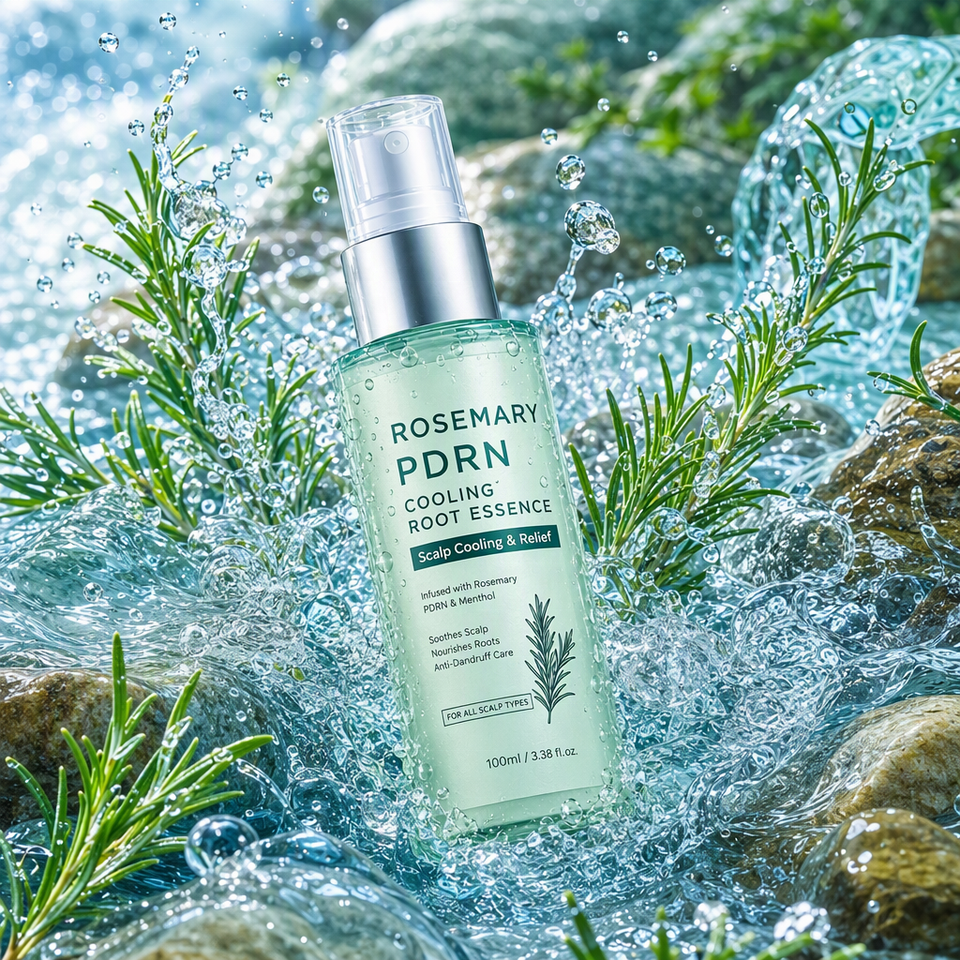
LANTHOME lists Rosemary PDRN Scalp Spray, reference 1601993583246 as a 100 mL scalp spray in a green source variant. The page lists PDRN and rosemary as ingredients, screen printing as the logo customization method, and Private Label / OEM / ODM as the service scope. It does not publish a model number, complete INCI list, ingredient levels or sources, final formula specification, directions, claim evidence, spray-output specification, packaging material, commercial terms or target-market assessment.
This guide therefore treats the page as a catalog identity rather than a finished technical dossier. The task is not to decide whether an ingredient name sounds persuasive. It is to create a brief in which each statement points to a controlled formula, package, direction and evidence record. The cover and catalog images are visual references only; neither confirms the final package.
Product Facts and Confirmation Points
- Catalog identity: The page identifies LANTHOME Rosemary PDRN Scalp Spray, reference 1601993583246. No model number is specified, so the source reference should remain on the inquiry and every sample record.
- Format and listed size: The stated format is a 100 mL scalp spray. Confirm the net-content declaration, fill specification, spray system and final directions for the proposed market.
- Listed ingredient direction: PDRN and rosemary are listed ingredients. The page does not provide the complete INCI list, concentration, grade, source, function, specification or finished-formula evidence.
- Source variant: Green is the listed source variant. Confirm whether this describes the bottle, decoration, liquid appearance or another catalog attribute before using it in a package brief.
- Decoration: Screen printing is listed as the logo customization method. Confirm the printable area, color count, substrate, artwork tolerances and approved physical sample.
- Service scope: Private Label / OEM / ODM is stated. The exact formula, package, quantity, price and timing remain project-specific questions.
- Unpublished controls: Directions, warnings, compatibility, spray output, stability, claim substantiation, MOQ, capacity and lead time are not published.
Use four identifiers even if the supplier initially provides only one. The product reference identifies the catalog source. A formula or sample code identifies the liquid. A component code identifies the bottle, pump and cap. An artwork revision identifies the decoration. A decision that names all four is far easier to audit than an approval such as “green rosemary spray approved.”
Which Brief Should Lead the Project?
Two routes are practical. An ingredient-led brief begins with the formula identity and evidence boundaries. An application-led brief begins with spray delivery, directions and routine fit. Both require the same controls, but selecting a lead route helps the buyer decide what must be resolved before artwork.
Option 1: Ingredient-Led Brief
- Primary decision: What exactly do PDRN and rosemary mean in the identified finished formula, and which statements can be supported?
- Sample control: Match every sample to a formula revision, complete ingredient information and the supplier's current specification.
- Evidence needed: Ingredient identity and specification, finished-product documentation, proposed claim wording and support applicable to the target market.
- Package role: Keep ingredient communication subordinate to confirmed identity, directions, warnings and required label information.
- Change trigger: A change in supplier, level, grade, extract, fragrance or formula revision may require renewed document and copy review.
- Best fit: Projects in which ingredient discovery is the main merchandising or search route, provided the evidence file is ready before claims are approved.
This route can make the product easy to categorize, but it creates a common error: turning a listed ingredient into an outcome. “Contains,” “with,” “powered by,” “supports” and performance language are not interchangeable. Each proposed phrase should be reviewed against the exact formula and applicable evidence. Do not infer regeneration, growth, repair, anti-loss, clinical results or medical suitability from the catalog name.
Option 2: Application-Led Brief
- Primary decision: Can the exact bottle and formula deliver a clear, repeatable scalp-application routine under confirmed directions?
- Sample control: Review the identified formula in the intended spray system, not only in a laboratory or temporary container.
- Evidence needed: Pump specification, output information, compatibility records, confirmed directions and support for any use or sensory statement.
- Package role: Make the application area, sequence, storage and warnings readable while controlling spray access and closure.
- Change trigger: A pump, actuator, bottle, fill, viscosity or direction change may require another compatibility and use review.
- Best fit: Projects organized around routine steps, applicator formats or professional workflow rather than ingredient-first navigation.
This route emphasizes the user task without promising an outcome. A spray can be described as a format only after the actual component is confirmed. Terms such as “fine mist,” “targeted,” “non-drip,” “even,” “quick-drying” or “mess-free” require a defined component and appropriate support; they should not be copied from a generic packaging assumption.
Build a Traceable Sample and Evidence Review
1. Define the decision and target context
Write one question before requesting a sample: “Can reference 1601993583246, in the proposed spray package, support our intended scalp-care routine and approved ingredient communication?” Add the target country or region, sales channel, audience context and planned range role. State whether ingredient discovery or application convenience leads the product hierarchy.
Do not begin with a broad goal such as “approve PDRN scalp growth spray.” That wording assumes an outcome the page does not establish. A useful first gate covers identity, application clarity, package handling and documentation readiness. It does not approve production, medical positioning or performance claims.
2. Request the current formula identity
Use reference 1601993583246 because no model is specified. Ask for the sample code, formula revision, manufacturing or sample date, complete ingredient information and current product specification. Ask how the listed PDRN and rosemary entries appear in the applicable ingredient declaration and what supplier documentation is available.
Keep ingredient direction and finished-product proof separate. A raw-material specification can help establish identity, but it does not automatically validate the performance, stability or public claims of the finished spray. Record which document supports which statement and mark unanswered fields as pending.
3. Convert every planned claim into a review row
Create a claim matrix with five fields: exact proposed wording, where it will appear, formula or component it refers to, evidence owner, and status. Start with neutral identity language such as “scalp spray” and the confirmed ingredient declaration. Add stronger wording only after the applicable review.
Avoid umbrella approvals such as “all PDRN claims approved.” A product title, product-page sentence, paid advertisement and package claim may carry different context and requirements. Keep the wording exact. If the evidence supports only ingredient presence, do not extend it to regeneration, strengthening, reduced shedding, thicker-looking hair or treatment language.
4. Define the spray system as a specification
Request the proposed bottle, actuator, dip tube, cap, gasket or other relevant components, material information, dimensions, decoration area and supplier component codes. Ask for the applicable output and spray-pattern information rather than assuming the pump creates a fine mist. Record whether the green source variant is a bottle color, decoration, liquid cue or unconfirmed visual reference.
Review the formula and package together. Viscosity, component materials, storage and transport can affect delivery and compatibility. A bottle photograph cannot demonstrate spray pattern, leakage resistance, compatibility or recyclability. If the component changes, reopen the affected review fields.
5. Lock the confirmed directions
Ask for the application area, preparation, amount or actuation guidance, frequency, contact or leave-on instructions, storage and warnings that apply to the exact formula. Do not invent directions because another scalp spray uses them. The supplier's direction version should appear in the sample record and copy review.
During an internal use review, capture only neutral observations under defined conditions: ability to unlock or remove the cap, actuation consistency, where the spray lands, label readability and cleanup. Those notes help refine the brief, but a small internal review is not automatically claim substantiation.
6. Review formula, pump and decoration together
Screen printing is listed as the logo method, so request the actual printable area, artwork template, ink and substrate information, tolerances and approval process. Confirm whether required text can fit legibly with the brand design. An attractive logo sample does not approve ingredient wording or directions.
Use a filled, identified package for the relevant compatibility and handling review. Record the bottle, pump, cap, formula and artwork revisions. If the project uses a label instead of or alongside screen printing, confirm that change rather than assuming the catalog method covers it.
7. Create a change-control rule
Define which changes reopen which decisions. A formula or ingredient-source change may reopen ingredient, stability, evidence and copy review. A pump change may reopen delivery, compatibility, directions and artwork. A target-market change may reopen labeling and claim assessment. A color change may reopen decoration approval even if the formula is unchanged.
Put the rule in the project brief before samples multiply. Otherwise, teams may compare observations from different formula or component versions as if they were one product. Traceability is more valuable than a large collection of unlabeled samples.
8. Issue separate decisions
At the review meeting, issue a formula decision, package decision, directions decision and claims decision. Then issue a parent decision for the exact combination. “Proceed” means ready for the next named stage. “Revise” must identify the field and owner. “Hold” should name missing ingredient information, pump data, compatibility work, directions, evidence or commercial terms.
This prevents one successful visual review from releasing everything. For example, the screen print may be approved while the ingredient wording remains on hold. Conversely, the formula identity may be clear while the pump and label area still require revision.
Keep Ingredient Identity, Mechanism and Outcome Separate
Ingredient identity answers what is present under the applicable declaration and specification. A proposed mechanism explains how someone believes an ingredient may act; it is not automatically a finished-product result. An outcome claim states what the actual product does under defined use conditions and therefore needs appropriate support.
For this catalog reference, only the ingredient direction is stated. The page does not establish a mechanism, concentration, delivery to a biological target, clinical outcome or consumer result. A responsible brief should not fill those gaps with general internet descriptions, supplier marketing language or research on a different material, route or formula.
The same separation applies to rosemary. The word can refer to different ingredient forms or functions, and the page does not specify which one. Ask for the exact declaration and specification. Do not add essential-oil, natural, organic, scalp-stimulating or hair-growth language unless the exact proposal and evidence support it and the target-market review permits it.
A Hypothetical Buyer Example
Consider a hypothetical brand planning a scalp-care step for online retail. The team chooses an application-led brief because the range is organized by routine. It requests reference 1601993583246, the formula revision and complete ingredient information, then asks for the proposed green bottle and spray-component codes. The team lists PDRN and rosemary only as pending ingredient communication until the documentation and final declaration are reviewed.
One internal session follows the supplier-confirmed directions and records pump operation, placement and label readability. A separate document review maps exact product-page phrases to evidence. The design team uses the screen-printing template but does not add growth, repair or clinical language.
If the formula record is complete but the pump specification is missing, the formula decision may proceed to document review while the package and parent decisions remain on hold. This is a planning example, not an actual customer case, result, test or endorsement.
Frequently Asked Questions
Does the catalog page prove that the spray contains a specific amount of PDRN?
No. The page lists PDRN and rosemary as ingredients but does not publish their levels, complete INCI list, grades, sources or formula specification. Request the current formula and applicable documentation for the exact sample. Do not infer a percentage or performance from the product name.
Can a brand make hair-growth or regeneration claims from the ingredient names?
Not from this page. Ingredient listing does not establish a finished-product outcome, medical suitability or approved market wording. Define each proposed statement precisely, identify the formula and directions it covers, and request applicable evidence and target-market review before using stronger claims.
Is the pictured green bottle the final private-label package?
No. Green is a listed source variant, but the page does not define the final bottle, pump, material or decoration specification. Ask for the actual component proposal, physical sample, screen-printing template and compatibility information. Treat catalog images as references rather than approvals.
Does “scalp spray” mean the package creates a fine mist?
No. It identifies the product format, not a verified spray pattern or output. Request the actuator and pump specification and review the exact filled package under confirmed directions. Avoid fine-mist, targeted or even-coverage language unless the actual component and evidence support it.
What should be approved before artwork begins?
At minimum, approve the product and sample identity, complete ingredient information, proposed package and decoration area, confirmed directions, required label content and the status of every planned claim. Price, quantity and timing should also be confirmed for the defined configuration rather than a generic catalog reference.
What to Send in Your Inquiry
- Catalog reference: 1601993583246; note that the page does not specify a model.
- Project route: State whether ingredient communication or spray application leads the positioning.
- Formula request: Ask for the current sample code, formula revision, specification and complete ingredient information.
- Ingredient questions: Ask how PDRN and rosemary are identified and documented for the exact proposal.
- Package brief: Define preferred bottle, pump, cap, color, decoration, secondary pack and channel.
- Directions: Request the confirmed application area, amount or actuations, frequency, storage and warnings.
- Claims matrix: Send the exact ingredient, routine, sensory and performance wording for evidence review.
- Commercial questions: Request current customization options, quantities, pricing and timing for the defined formula-package combination.
Send the identified request through the LANTHOME contact form or organize a controlled sample through the sample request form. The Private Label Roll-On Scalp Serum guide offers a useful contrast: it shows why applicator logic should be reviewed separately from formula and ingredient claims.
Related Links
- LANTHOME Rosemary PDRN Scalp Spray- Review the exact 100 mL catalog reference used for this evidence brief.
- Scalp Serum Collection- Compare current scalp-care formats without assuming formula or claim equivalence.
- Private Label Roll-On Scalp Serum: An Applicator Brief- Compare spray and roll-on application controls.
- Private Label Scalp Care Spray: Map the Application- Review another spray-focused buyer workflow without transferring product facts.
- How It Works- Review the private-label, semi-custom and custom development routes.
- Request Haircare Samples- Request one identified formula and package combination for review.
- Contact LANTHOME- Send the formula, component, market, evidence and commercial questions.